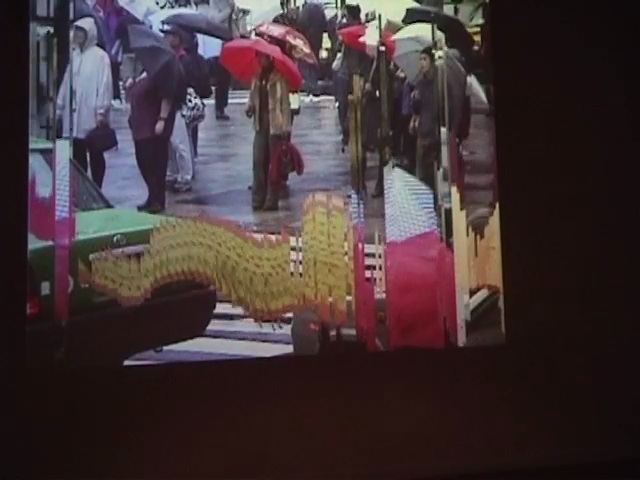
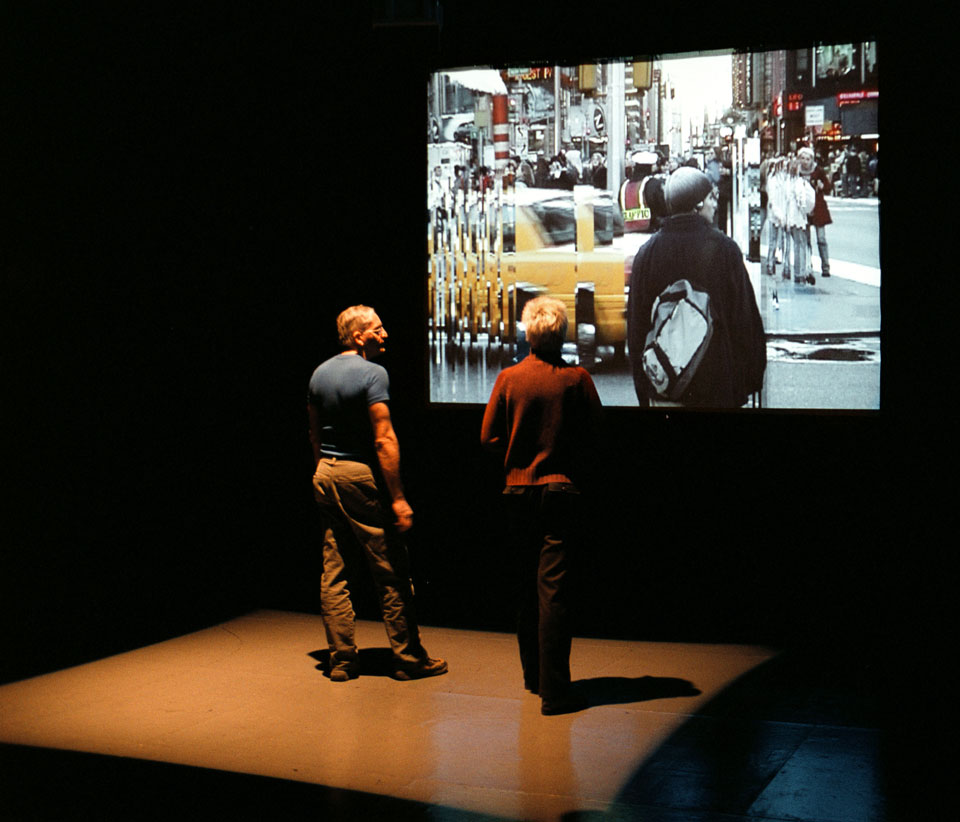
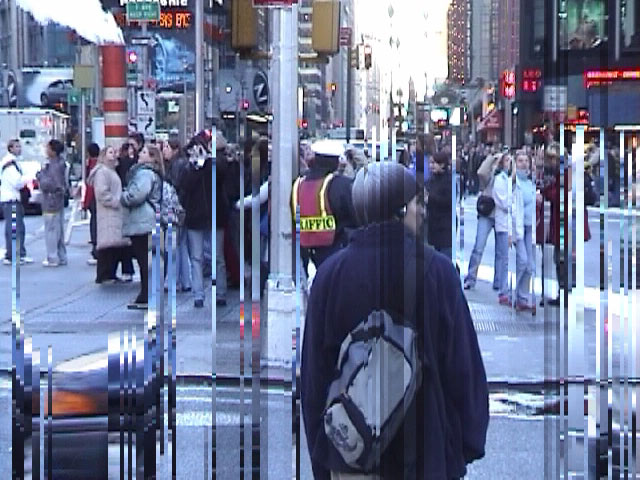
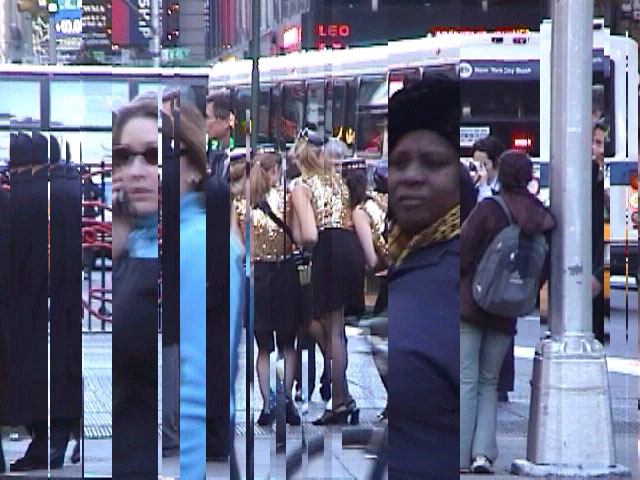
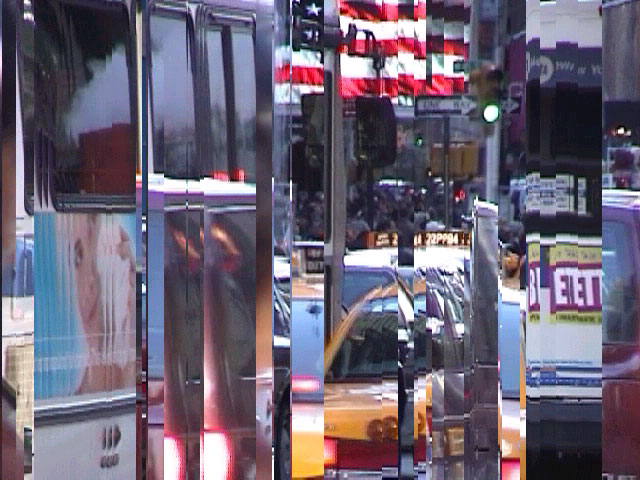
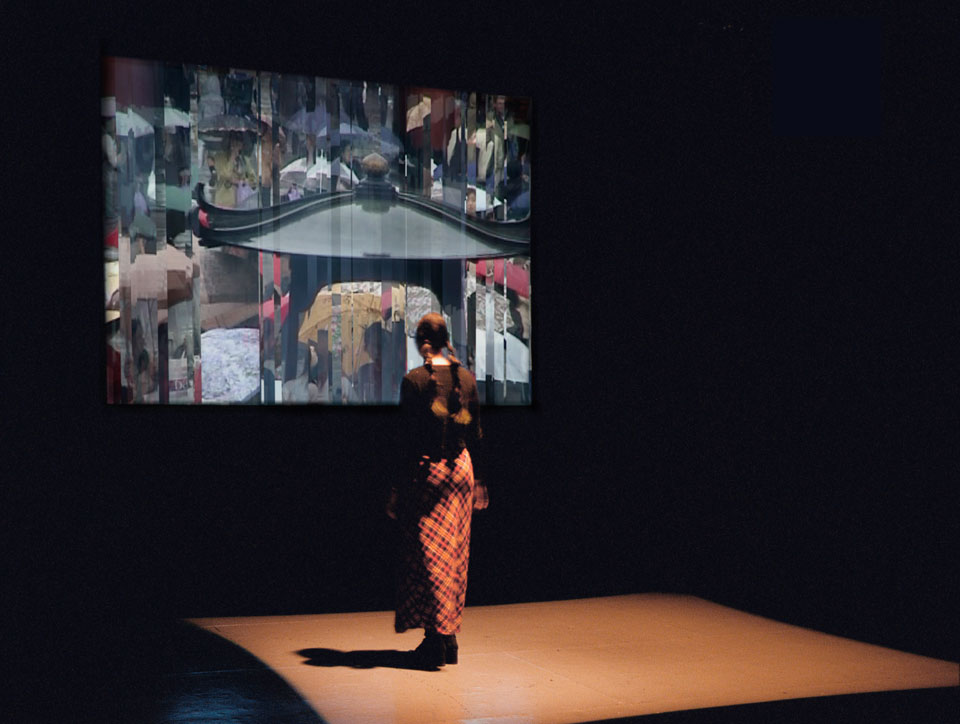
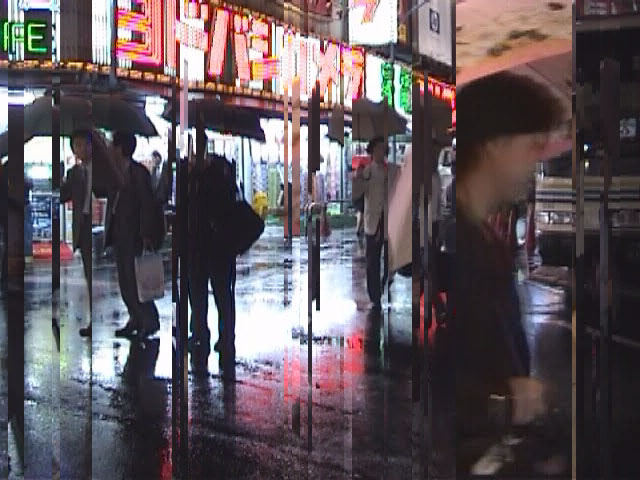
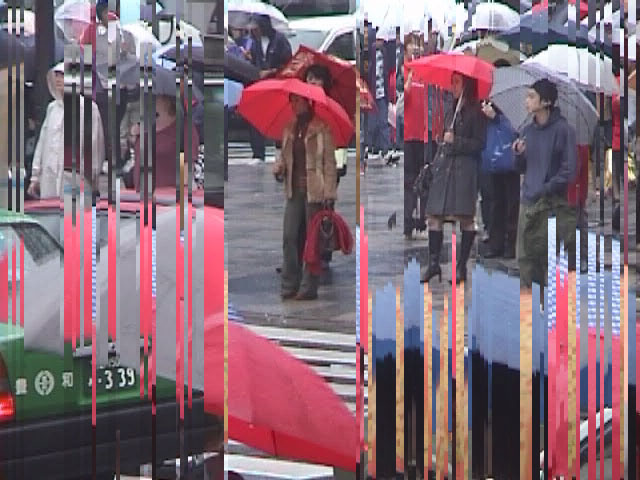
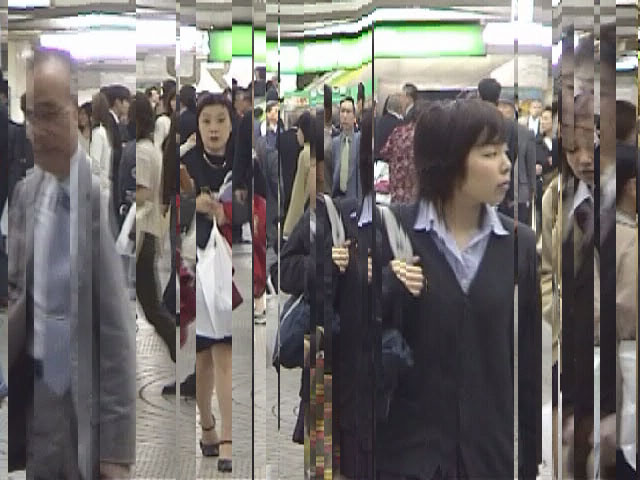
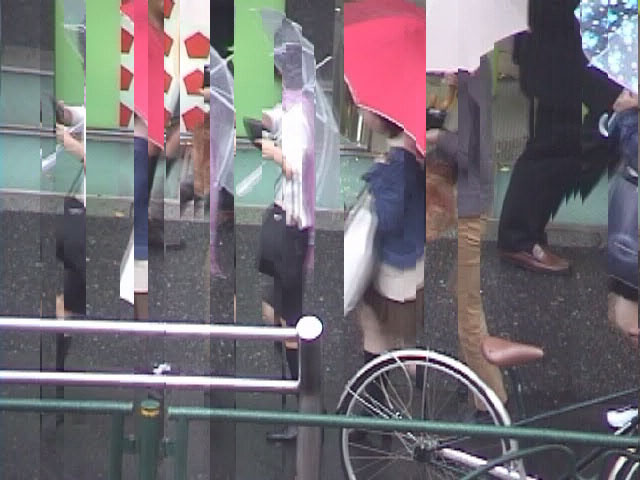
The Liquid Time Series explores how the concept of ‘point of view’ is predicated on embodied existence. Initially, the piece was an attempt to create an interactive installation where users’ physical positions in the gallery (tracked by an overhead camera) controlled different ‘perspectives’ in a collage-like projection. The result of this exploration, however, is a series of pieces in which imagery of time, as well as space, is disrupted by users’ motions.
In the Liquid Time Series installation, a participant’s physical motion in the installation space fragments time in a pre-recorded video clip. As the participant moves closer to the projection screen they push deeper into time—but only in the area of the screen directly in front of them. Beautiful and startling disruptions are created as people move through the installation space. As viewers move away, the fragmented image heals in their wake—like a pond returning to stillness. The interface of one’s body—which can only exist in one place, at one time—becomes the means to create a space in which multiple times and perspectives coexist. The resulting imagery can be described as video cubism. To create this imagery Utterback’s software deconstructs the video frame as the unit of playback. This piece destabilizes a basic premise of time based media—that the unit of recording is also the unit of playback.
The current Liquid Time Series consists of two distinct pieces, Liquid Time—Tokyo, and Liquid Time—New York. In each piece, participants interact with images from sites in these cities where humans, data, or other physical matter are transferred or in transit. Participants’ movement back and forth in front of the screen both echoes and controls the movements of busy pedestrians. People on screen are set in motion by motions off screen—shimmering in and out of existence. The composition in each video clip is anchored by static elements that become stable armatures in the chaos of fragmentation—street signs, trash cans, a person standing oddly still. The unexpected permanence of certain elements (and the transience of others) hint at how both personal and cultural memory have a physical component subject to the unpredictable nature of decay.
Collections:
Hewlett Packard Company, Liquid Time series – New York and Tokyo, Executive Briefing Center, Houston, TX
Exhibition History:
Frist Center for the Visual Arts, Nashville, TN. 2013 (Liquid Time Series – New York)
Frist Center for the Visual Arts, Nashville, TN. 2013 (Liquid Time Series – Tokyo)
Contemporary Art Center of Virginia, Virginia Beach, VA. 2009 (Liquid Time Series – Tokyo)
Skive Kunstmuseum, Skive, Denmark. 2009 (Liquid Time Series – New York)
The Valencia Institute of Modern Art, Valencia, Spain. 2007 (Liquid Time Series – Tokyo)
The Exploratorium, San Francisco, CA. 2004 (Liquid Time Series – Tokyo)
The Fabric Workshop and Museum, Philadelphia, PA. 2003 (Liquid Time Series – Tokyo)
The American Museum of The Moving Image, Queens, NY. 2003 (Liquid Time Series – New York)
The Kitchen, New York, NY. 2002 (Liquid Time Series – New York)
The Art Interactive, Cambridge, MA. 2002 (Liquid Time Series – Tokyo)
Mass MoCA, North Adams, MA. 2002 (Liquid Time Series – Tokyo)
Netherlands Institute for Media Art, Amsterdam, The Netherlands. 2002 (Liquid Time Series – Tokyo)
IAMAS “Interactions ’01”, Ogaki City, Japan. 2001 (Liquid Time Series – Tokyo)
New York University, New York, NY. 1999 (prototype)